As we observe Memorial Day, we honor those who died while serving in one of the branches of our nation’s military. More than a million have now given the ultimate sacrifice for our country in the conflicts that have occurred since the Revolutionary War.
Also, in a few days June 6th of this year will mark the 80th anniversary of the famous D-Day invasion on the beaches of Normandy in World War II. This incredible military operation involved many thousands of Allied personnel, all doing their part. Recently, I read a reprint of a 1994 Peanuts newspaper strip in which Charles Schultz commemorated the 50th anniversary of D-Day. Appearing in the June 6th edition of newspapers across America in 1994, Schultz used Snoopy, who adopted his persona of a “World Famous G.I.” charging through the surf at Omaha Beach, in order to pay tribute for this special observance. The Peanuts newspaper strips for the next four days continued the tribute, concluding with the “World Famous G.I.” writing a letter to his Mom in which he expressed his hopes for a quick end to the war following the successful invasion.
I have long known of the critical role played by the “Higgins boats” in the landing of some 100,000 soldiers on D-Day. However, I only recently became aware of the Andrew Jackson Higgins National Memorial in Nebraska. Praised by General Eisenhower as “the man who won the war for us,” Higgins was the man who designed and built the LCVPs – long, flat boats with doors on the front that fold down – that made it possible to land soldiers on an open beach. This memorial includes a full-size steel replica of a LCVP boat and a Memorial Walk featuring brass stars holding sand samples from the D-Day beaches on which these boats landed in 1944. As we mark the 80th anniversary of D-Day on June 6th, we again remember the contributions of unlikely war heroes such as Higgins, a boat-builder from Nebraska!
Charles Schultz, himself a veteran of World War II, is no longer around to mark this 80th anniversary with us. For those of us whose parent(s) served in the war, it seems impossible that battle is already 80 years old. Time marches on, but we gratefully pause to remember those who served and those who gave their all for the rest of us.
Homeschool Conference Season Is Here Again
What a blessing and a privilege to be able to meet home school families and share tools and ideas that they might not have considered using to help their children be more interested in and engaged in the topics they are studying – especially in history!
We had a great time at The Great Homeschool Convention in Greenville, SC a few weeks ago. In addition to visiting with families at our booth, Matt gave his presentation, “A Fresh Approach to 20th Century American History,” where he challenged families to use “untraditional” resources to teach history and also to focus on the experiences of their own families at different points in history. Most often, the history written in traditional textbooks impacted the typical citizen, but not always as much as the textbook may imply. Our families were often impacted by more local and regional events that may not be covered in a textbook.
In our current social media driven world, it can be easily forgotten that people weren’t always as “connected” or aware of events that occurred across the state where they lived – much less across the county or even the world! A family living in a rural community was probably more concerned about that factory in town shutting down and most of the workers there suddenly being without a job than they would be about the big news of the day happening in larger cities like Chicago, Los Angeles or even whatever was happening in Washington, DC. Keeping that in perspective when you study history – and then ‘digging in’ a little bit to the story of your own family can breathe new life into your history studies.
If you are planning on attending The Great Homeschool Convention in Cincinnati, Ohio this weekend, Matt will be giving the same presentation on Friday morning at 8:30, and he’d love to see you there! We will also be in booth 818 in the vendor hall. In addition to The Great Homeschool Conventions, we will also be attending the NCHE’s Thrive! Conference in Winston-Salem, NC May 23-25 and will be in booth 57. If you are attending either of these conventions, we’d love to have you stop by and chat with us! We do have some “Conference Special” packages, and we have new resource DVDs/flash drives that are only available at conferences and conventions.
Hope to see you at one of the conventions soon!
Amy
Happy Easter…80 Years Ago
It is now 80 years ago that my father, John McKenzie, was spending the Easter season in basic training at Camp Croft in South Carolina. A few weeks later, he would be shipping out to join the campaign that was about to commence in Europe.
During the second world war, Camp Croft was a WWII Army Infantry Replacement Center located near Spartanburg, SC.
John arrived at the beginning of January 1944 to begin basic training. During an interview in 2000, he recalled that upon arrival he was a typical wartime recruit: “you’re green, and you’re scared, and you don’t know what else to do, and you do what you’re told.” Weekdays were filled with drilling and training, but weekends offered a chance to relax and explore the nearby city of Spartanburg.
During the first week of February, John attended the Soldier’s Recreation Center of First Presbyterian Church in Spartanburg. The following week, the church office sent a postcard to his family back in Illinois to let them know of his visit: “We enjoyed having him with us and we look forward to his return.” The card was signed by a member of the Soldier’s Entertainment Committee.
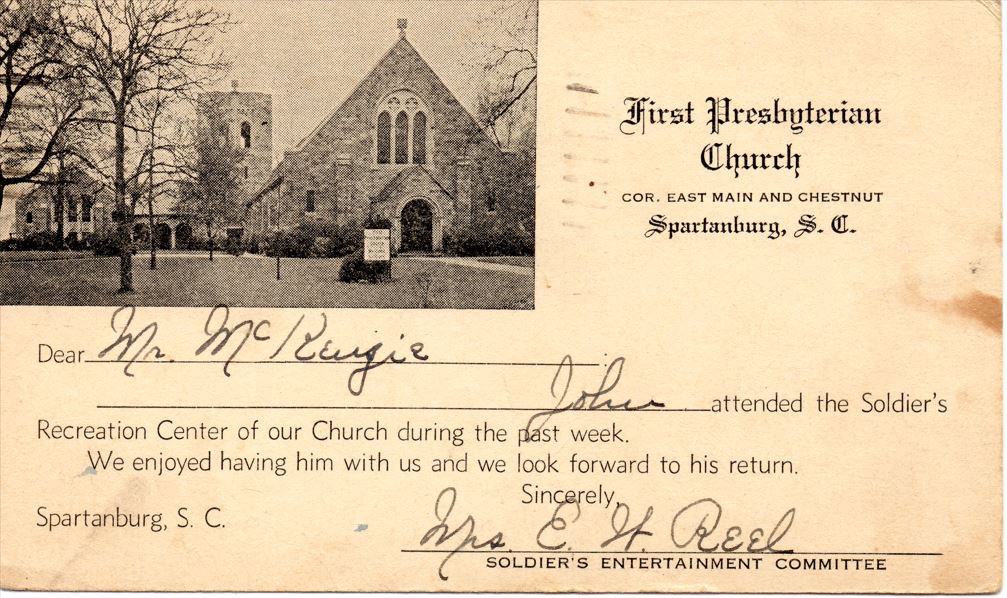
I have no direct evidence that John attended any Sunday services at First Presbyterian, but there is good circumstantial evidence that rather than returning to a Camp Croft chapel service, he may have at least returned to First Presbyterian Church on Sunday, March 26, for a morning Easter service. John sent home three postcards that were each dated March 26, 1944. On the back of the one with a nice color picture of First Presbyterian Church, John wrote that he thought it was a “pretty” church. On the card featuring the Greyhound Bus Depot, located just a few blocks from the church, he noted that he was spending Easter afternoon at the U.S.O. in Spartanburg. Finally, the third postcard contained his Easter greetings to the family.
While traveling recently through Spartanburg, I had a chance to drop by First Presbyterian Church. It was on a Sunday morning and I did not wish to venture inside since my wife and I did not have time to linger and we did not want to interfere with the Sunday services. We did however take a few snapshots of the exterior. The church’s appearance is almost a perfect match with the pictures John had sent to the family, creating a “you were there” feeling for me. As a casual observer, the only obvious changes I could see were that a newer addition to the part of the building nearest the street corner had been constructed, and the sign in the front lawn is newer and larger than the old 1944 sign visible in the postcard.

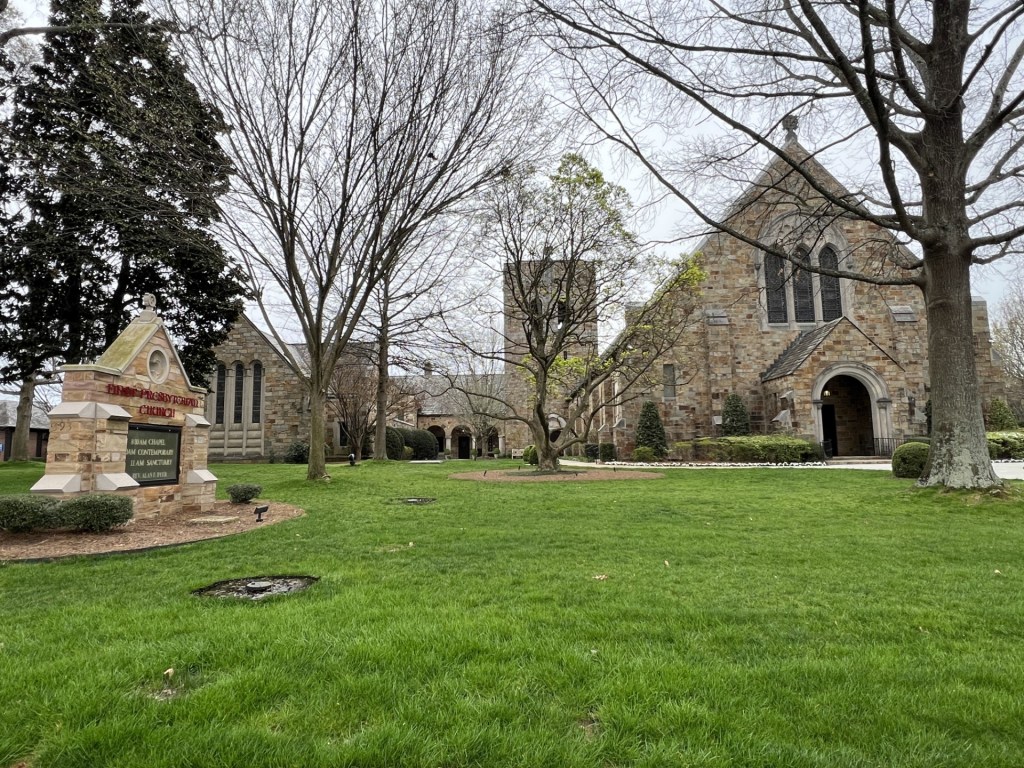
After the war, the Army sold the Camp Croft property and the former camp area has since been completely converted to civilian use, including residential housing and businesses, and a significant portion is now Croft State Park.
It was a neat feeling to be in the same area where my Dad had spent that Easter season, and maybe even that Easter Sunday morning, 80 years ago! It was also exciting to observe that First Presbyterian Church seems to be carrying on a vibrant ministry in the community today, just as they were doing in 1944.
I will echo my Dad’s message from that Easter 1944 postcard and wish a Happy Easter for all of you.
George McKenzie Turns 120 on 30th Birthday!
My grandfather, George McKenzie, a “leap year baby” born February 29, 1904, always enjoyed referring to his age by the number of birthdays he had celebrated. Thus, were he still living, George would just now be celebrating his 30th birthday!
For me, he was a family connection to two of my favorite parts of American history – the Old West and the Great Depression years.
George was born in Oklahoma Territory (Oklahoma became a state in 1907), where his father, William, worked as a cowboy for twelve years. This likely accounted my grandfather’s love of western stories. From my father I learned that George was an avid reader of Zane Grey novels during my father’s childhood years. He said George was sometimes known to stay awake long into the night reading Zane Grey’s latest work. During my own childhood, I have cherished memories of watching episodes of Gunsmoke and Bonanza while the family was spending an evening at Grandpa’s house.
By the time the Great Depression was in full swing in the 1930s, George was living in Illinois, married, and the father of four children. Like so many others, he was often without a job. He eventually accepted a job with the WPA driving a truck as part of the road and bridge work being done in the area around Litchfield and Hillsboro. The WPA, the Works Progress Administration, was one of the Federal government’s New Deal agencies that provided paying jobs to the unemployed, mostly in construction work.
A bridge in a low-lying farmland area a few miles west of Hillsboro was built during those Depression years, and George was part of the team that built that bridge. When the concrete for the bridge’s pillars was poured, the weather was very cold, especially at night. To allow the concrete to properly set up in the cold temperatures, fires were built around the pillars and kept burning through the night. George was the man who stayed up through the night tending those fires. My father, still a young boy at the time, was able to be with him during those nights. As of the summer of 2008 when I saw it, that bridge was still standing and still safe for automobile traffic!
When I think about my grandfather, that “leap year” baby of 1904, I also think of how much change has happened in the past 120 years. He did not survive to see home computers, or cell phones. However, he lived through some incredible times during his life, including: the beginnings of the film industry; the first airplanes; the development of the personal passenger automobile; World War I; the rise of radio; the Great Depression; World War II; jet aircraft; the debut of television; satellite communication; and man’s first walk on the moon!
His story is a wonderful part of my family’s intersection with our 20th Century American history and heritage.
My Christmas Carol
Christmas Day is almost here! The season has so far been filled with the usual holiday activities and time well-spent while gathering with cherished friends and family.
Looking back over the years past, Christmas always included fun times with friends and neighbors. Early in life, there were Christmas activities in school classrooms with childhood friends. The whole town seemed to turn out for one or more Christmas events throughout the month of December. The local churches sponsored community-outreach efforts in addition to their special Christmas programs. My family decorated our house, and looked forward to hosting grandparents during portions of the holidays.
As in the past, the present Christmas season has been a busy one. A seemingly endless list of tasks to accomplish, events to attend, and personal to-do’s has made the time fly by quickly. In all the flurry of activity that can often seem a bit overwhelming, there is also a sense of thankfulness that we can still enjoy the season.
Looking into the future, let us seek to strengthen our relationships with friends and family, and to realize increased feelings of hope, peace and love in our homes.
As we continue to enjoy the current holiday season, I would like to echo the blessing of Dickens’ Tiny Tim by stating:
“A Merry Christmas to us all; God bless us, everyone!”
 MATTHEW McKENZIE